
AUTOMATED NDT SYSTEMS
Automated fluorescent penetrant inspection systems engineered to eliminate operator variability and deliver consistent surface defect detection with complete process traceability for aerospace, energy and precision manufacturing industries.
Request a System Consultation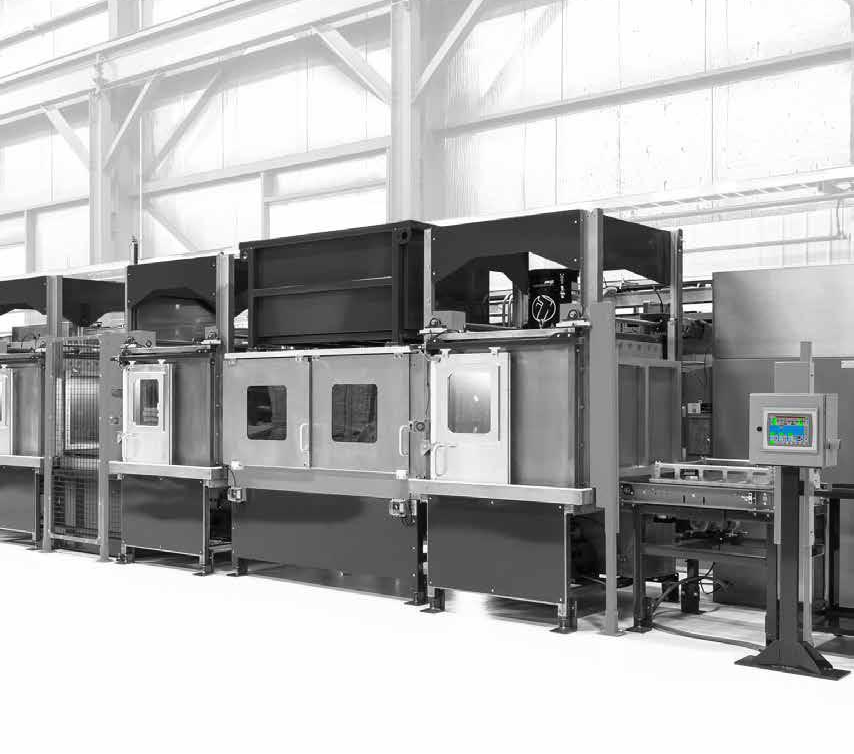
Fluorescent penetrant inspection is one of the most widely used surface NDT methods for detecting open-to surface discontinuities — cracks, porosity, laps, folds, and seams — in metallic and non-metallic components. In manual application, it is also one of the most process-sensitive: every stage of the FPI sequence — penetrant application, dwell time, emulsification, wash, dry, developer application, and UV inspection — introduces the potential for human variability that can compromise detection reliability.
Altair Systems' Robotic FPI systems automate the complete penetrant inspection process — from penetrant application through UV inspection and defect assessment — delivering consistent, repeatable, and fully traceable results at production throughput rates. Process parameters are controlled and logged at every stage. Operator subjectivity is eliminated from the detection step through automated UV imaging and AI-assisted indication analysis.
The result is an FPI process with measurably higher and more consistent probability of detection (PoD) — documented, repeatable, and fully auditable.
INSPECTION PROCESS
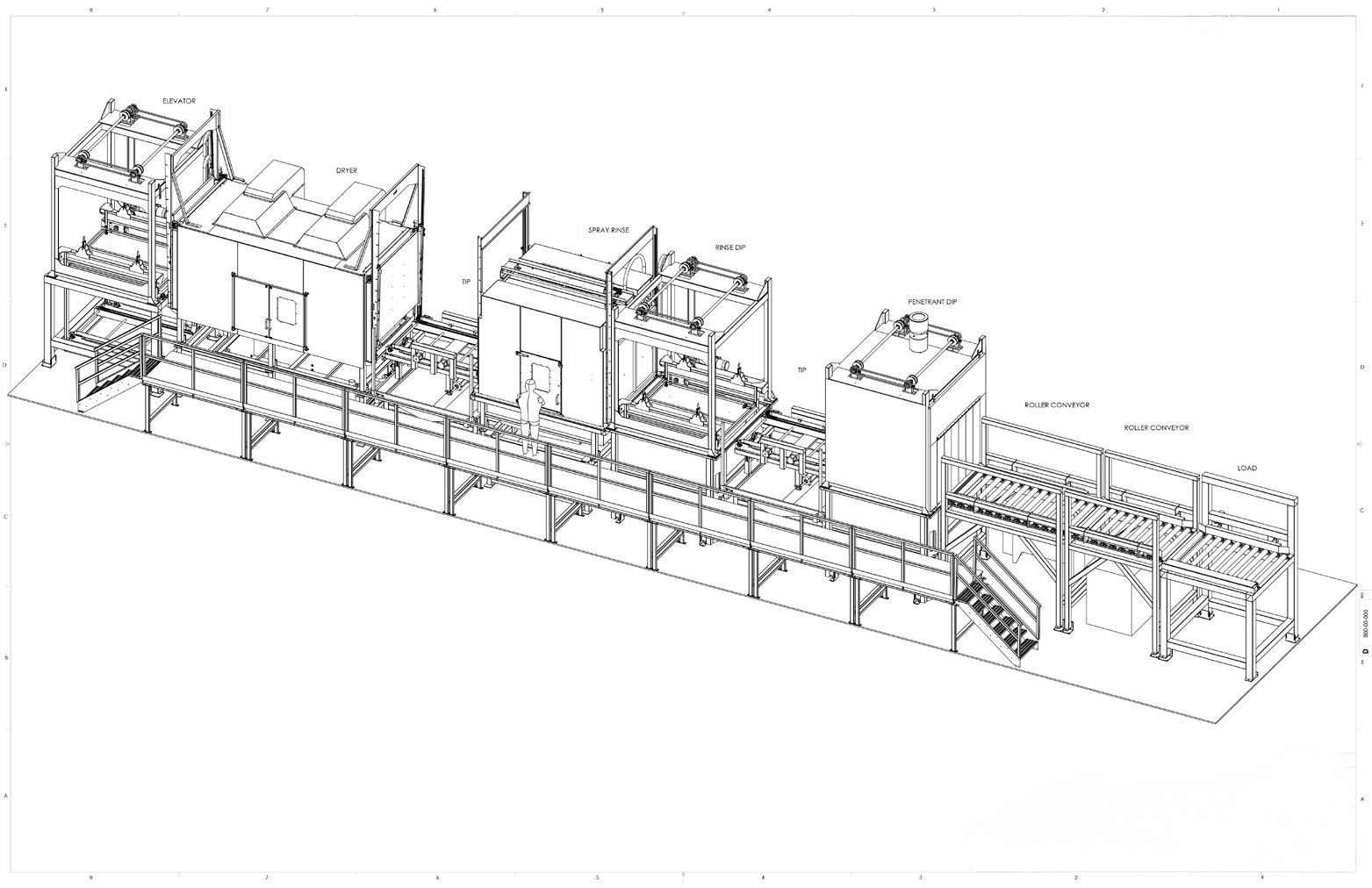
Process Steps (7 stages):
Stage 1: Pre-Cleaning Automated pre-clean station removes surface contaminants that could mask or trap penetrant. Process parameters — wash medium, temperature, duration, and dry-off — are controlled and logged.
Stage 2: Penetrant Application Robotic application of fluorescent penetrant — Type I (fluorescent) or Type II (visible) — by spray, dip, or flow-coat method, depending on component geometry and production requirement. Penetrant type, batch, and application parameters are recorded per inspection lot.
Stage 3: Dwell Time Control Penetrant dwell time is precisely controlled by the system — not estimated by the operator. Timer-managed transfer between stations ensures minimum and maximum dwell parameters are consistently met for every component, regardless of production rate.
Stage 4: Emulsification (Method B/D) Where water-washable penetrant methods are not applicable, robotic emulsifier application and dwell time control ensure consistent lipophilic or hydrophilic emulsification — the stage most vulnerable to operator inconsistency in manual processing.
Stage 5: Wash Controlled wash station with water pressure, temperature, and timing parameters managed by the system. Prevents over-washing (which removes trapped penetrant from fine discontinuities) and under washing (which leaves background fluorescence).
Stage 6: Drying & Developer Application Dry cabinet with temperature and time control. Automated non aqueous wet developer (NAWD) or dry developer application by robotic spray or fluidised bed, ensuring uniform coverage without pooling or missed areas.
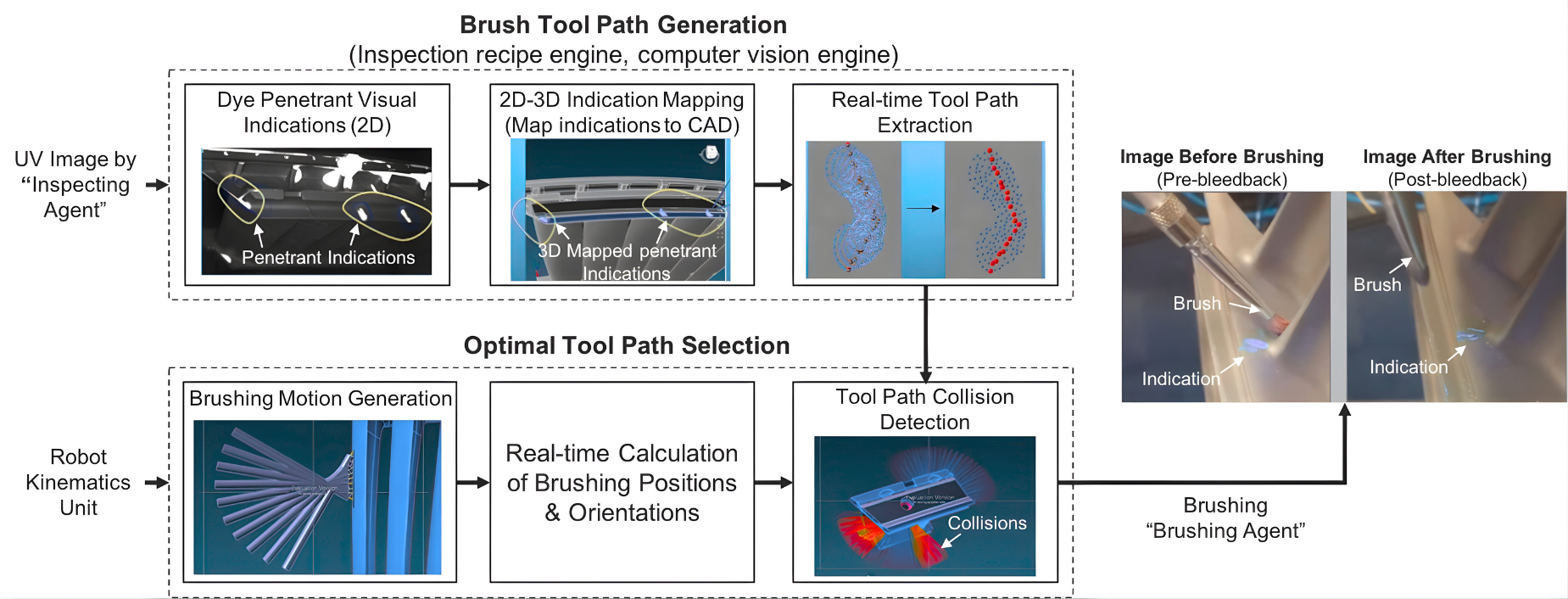
Stage 7: UV Inspection & Indication Assessment Robotic UV inspection station with calibrated UV-A illumination and automated camera imaging system. AI-assisted indication detection, characterisation, and location mapping — with human operator review of flagged indications for final accept/reject disposition.
CONFIGURATIONS
Configuration Cards:
Batch Processing FPI Systems Rack-loaded or basket-transfer FPI systems for batch production inspection. Automated process control with robotic part handling between stations. Suited to small and medium production volumes with mixed component types.
Inline / Conveyor FPI Systems Fully inline automated FPI lines for high-throughput production environments. Component transfer between stations via programmable conveyor or robotic handling. Designed for integration into the manufacturing production flow as a 100% inspection step.
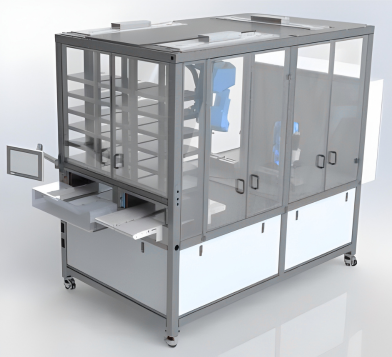
Robotic Cell FPI Systems Single or multi-robot FPI cells for complex-geometry components requiring articulated robotic handling. Six-axis robot manages component handling, penetrant application, and UV inspection positioning — enabling consistent coverage on turbine blades, vanes, and other complex profiles.
Aerospace & NADCAP-Referenced FPI Lines Complete FPI lines designed and qualified to AMS 2647, ASTM E1417 / E3022, EN ISO 3452, and OEM-specific process specifications. Full process audit trail and NADCAP audit-readiness documentation available.
INDUSTRIES
Industry Coverage:
Aerospace & Defence FPI systems referenced to AMS 2647, ASTM E1417, and NADCAP requirements. Complete process documentation and audit-trail capability. Applicable to turbine blades, vanes, disks, structural castings, and landing gear components.
Oil & Gas & Energy Penetrant inspection of pressure-containing components, valve bodies, pump housings, and weld areas to ASME, API, and EN inspection codes. Automated systems for refinery and upstream MRO inspection environments.
Power Generation Turbine blade and vane inspection during manufacture and MRO. High-throughput FPI systems for inspection of batches of turbine components during planned outage cycles.
Precision Manufacturing Automated FPI for precision-machined components where surface quality is a defined manufacturing acceptance criterion. Full integration with production workflow and ERP/QMS systems
THE CASE FOR AUTOMATION
Manual FPI Limitations:
Automated FPI Advantages:
WHY ALTAIR SYSTEMS
Automating fluorescent penetrant inspection is not simply a mechanical engineering problem. It requires a deep understanding of the FPI process — penetrant chemistry, surface energy interactions, UV illumination physics, developer application dynamics, and indication detection methodology — to engineer a system that genuinely improves inspection reliability rather than just replicating a manual process with robots.
Altair Systems brings NDT process expertise to every FPI system we design. We understand the inspection codes, the process qualification requirements, and the critical control parameters that determine whether an automated FPI system genuinely outperforms manual inspection — and we build systems that demonstrate that performance, measurably.